
Ray had twenty-six challenge coins in a cigar box in his closet, plus two small medals tucked in the same box. He could tell you where every one of them came from. Which ship, which year, which chief handed it to him across a table. But they lived in the dark, and any time he wanted to show one to somebody he had to dig through tissue paper to find it.
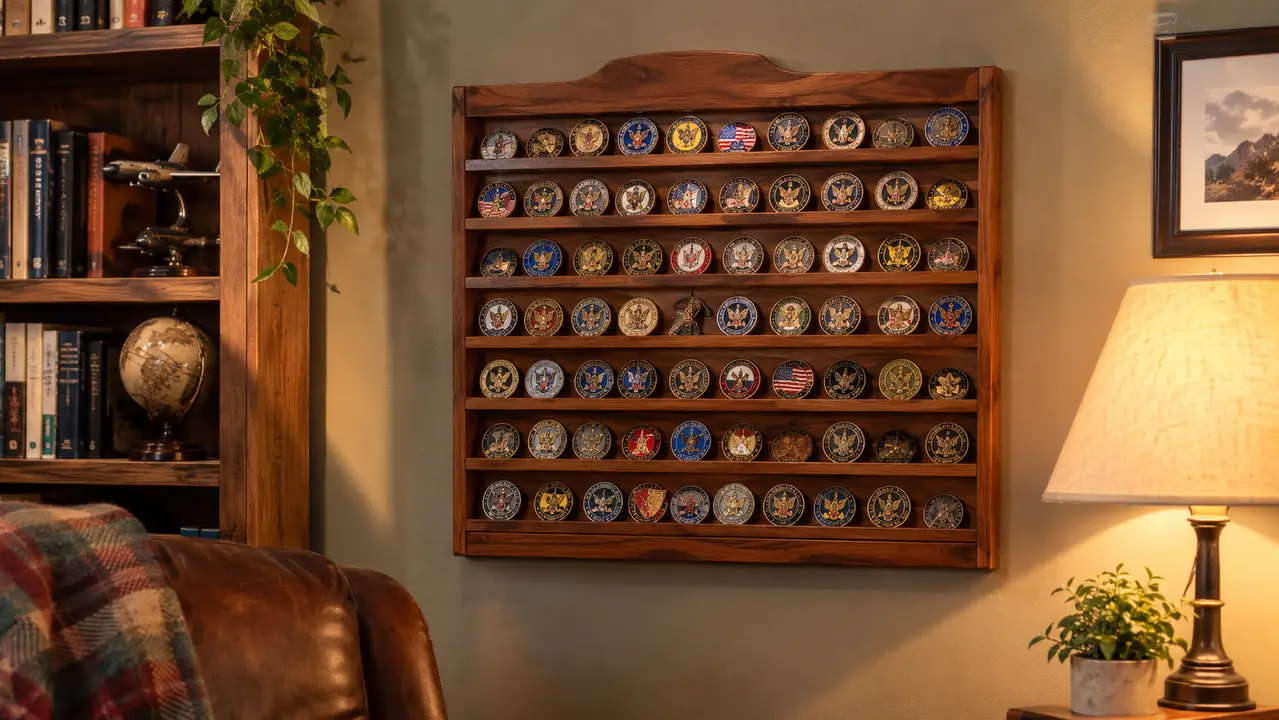
That is the whole problem with a collection kept in a box. A challenge coin is not really a thing you own. It is a thing you were handed, usually once, usually for something that mattered. In a cigar box in a closet, nobody asks about it. On a wall, people ask. In March I bought Ray the DisplayGifts Military Challenge Coin Display, the 7 tier wall model, 17.5 inches high and 14 inches wide. It took me about half an hour to hang with a stud finder and a level. He had the coins sorted on his kitchen table before I had the tools back in the case.
Here is what I learned doing it. The hanging is the easy part. What decides whether the thing looks right for the next ten years is the two steps before you touch a drill, and the one step after you finish.
See the 7 tier rack that got 26 coins out of a cigar box
Wall mounted, with metal brackets already on the back and grooves cut into every shelf so coins sit still. Ray's 26 coins and two medals fill less than half of it, which is the point.
Amazon Check Today's Price on Amazon →Step 1: Get every coin out of the box and onto a table
Clear a kitchen table and put a towel or a placemat down first. Coins are metal on wood and they slide, and a coin that lands on a hard floor can take a ding on the rim you will see for the rest of your life. I used an old bath towel folded twice. About four coins in, one of them slid off the edge of the table and landed on the towel instead of the linoleum, and nothing happened to it. On the bare floor that same coin would have a mark on it today. Get everything out of whatever it lives in now and lay it flat where you can see all of it at once. No stacking. One layer, spread out.
Count while you lay them out. Ray had 26 and I would not have guessed 26. There were also two small medals in with them that he had half forgotten about and was glad to see again. Write the number on a scrap of paper if it helps. You will want it in a few minutes when you are deciding how many rows to leave open and how many to fill.
This is also where you find out what you actually need. The rack gives you 7 rows with about 2 inches between them, and 2.25 inches at the top and bottom rows. Most challenge coins sit well inside that. A tall coin, or one of the big oversized ones, may not fit a 2 inch row without leaning, and you want to know that now rather than with a drill in your hand. Ray had two like that. He held each one up against the back panel of the empty rack to check it, and one came close enough that we gave it a spot on the bottom row, where there is that extra quarter inch.
Step 2: Sort them, and let the owner do it
Ray sorted his by ship first, then by year inside each ship. It took him maybe an hour at the table and he enjoyed the hour, which is not something I would have predicted when I carried the box in. Do not do this part for somebody else. The order is the point. The whole value of a coin is the story attached to it, and the man who was handed the coin is the only one who knows where it belongs in the lineup.
There is no wrong way to sort. By ship or unit, by year, by who handed it to you, or by putting the ones that mean the most at eye level and letting the rest fall where they fall. Ray went with ship and year, which pushed a couple of his favorites down to the lower rows. He did not care. He knew where they were. Two coins gave him trouble. He turned both over a few times and set them aside, then came back to them after the rest were laid out, and by then the year on one of them had reminded him. That is the sort of thing that happens when a man sits with his own coins for an hour, and it is why you do not rush this part or do it for him.
Then lay the sorted stacks out in the shape of the rack before you hang anything. Seven rows on the table, roughly how they will sit on the wall. You will see at a glance how much goes where, and you will see that 26 coins across 7 rows leaves a lot of open shelf. Do not let that bother you. Empty shelf is room, and the collection is not finished.
Step 3: Pick the wall, then pick the height
Pick the room before you pick the spot in the room. A den or a living room wall is right, somewhere a person sits and looks. Not over a heat register, not in a bathroom where the steam lives, not in a window that takes direct afternoon sun if the coins have a finish you care about. Ray put his in the den, on the wall you face when you sit in his recliner, which is the only wall in the house that made sense.
Height matters more than people expect. Put the middle of the display at eye level for the man who will look at it most, and let everybody else bend a little. We measured from the floor to Ray's eye and got 63 inches, then put the center of the 17.5 inch rack on that mark, which put the bottom edge just above 54 inches and the top just under 72. If small grandchildren use the room, keep the bottom row above the reach of the smallest one, because a coin on an open shelf is a coin a child will want to touch. There is no lid on this thing. That is the trade you are making for being able to see it.
One thing to get straight now: the rack hangs. It does not stand on a table or a shelf. The metal brackets are already on the back of it when it comes out of the box, and that is what it is built for.

Step 4: Find a stud, or use a real anchor
Find a stud. The DisplayGifts rack is about 2.1 kg empty, which does not sound like much until you add coins, and then consider that the piece is 17.5 inches tall, so it has some leverage against the wall. A stud is the right answer every time. If the only spot that works has no stud behind it, use a proper anchor rated for the weight, not the little plastic sleeve that comes in a picture hanging kit.
Mark your two holes with a pencil, check them with a level, and drill. The hardware comes in the box, so you are not hunting through a coffee can for matching screws. Two people make this easier, one to hold the rack flat against the wall and one to drive the screws. I did it alone in about half an hour, and most of that was finding the stud twice because I did not trust my first mark.
Hang it empty. Then stand back and look at it empty before a single coin goes in. If the height is wrong, fix it now. Moving it after it is loaded means handling every coin again, and handling is where rims get dinged.
Step 5: Load the shelves and leave the gaps
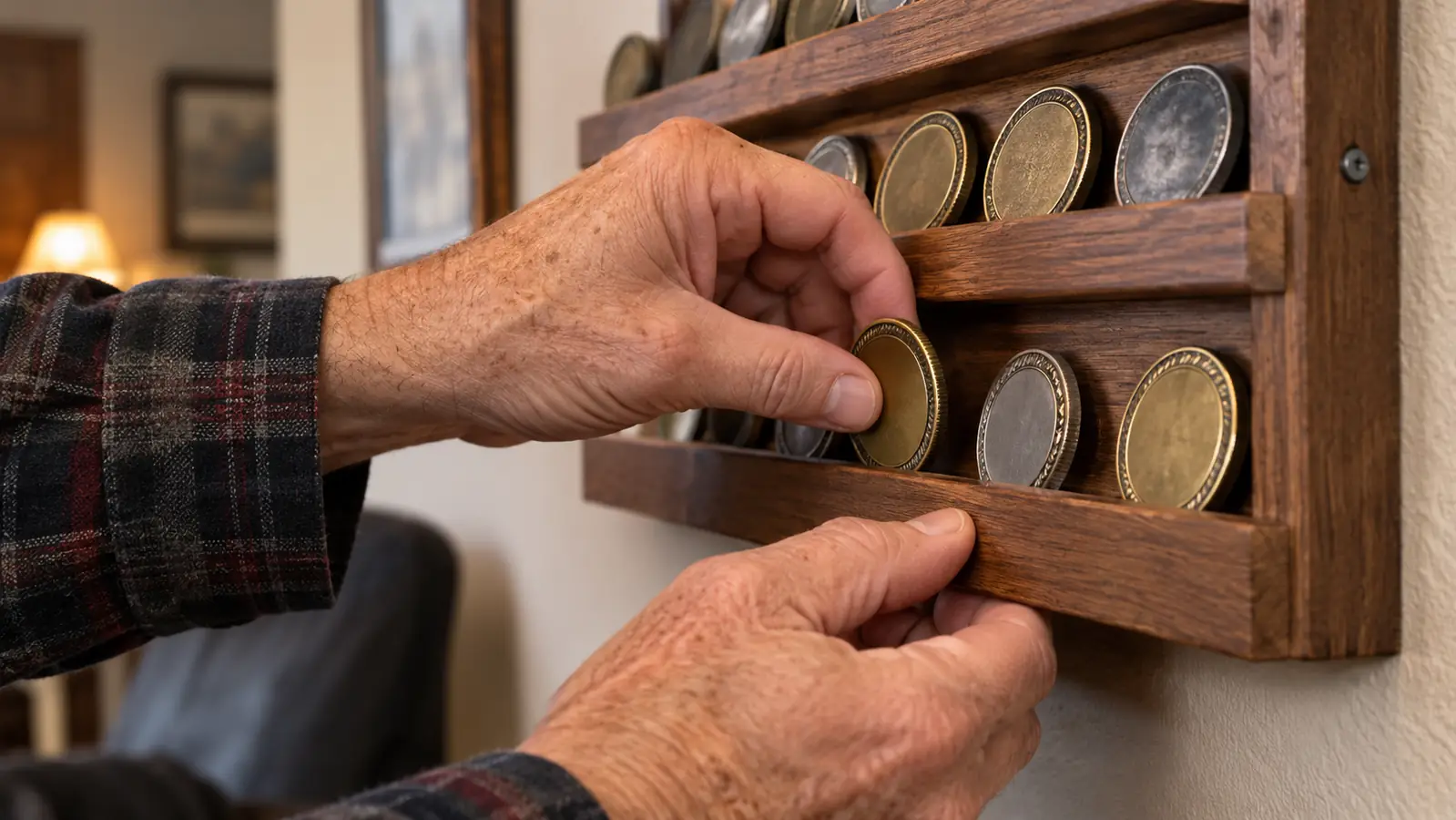
Start at the bottom row and work up. Each shelf has a groove cut into it to hold the coins upright and keep them from sliding when the door slams or the furnace kicks on. Set each coin down into the groove rather than leaning it against the back panel. A coin seated in a groove sits still. A coin leaning on a wall wants to fall the first time somebody bumps the wall.
Leave the gaps you planned at the table. A rack with three coins rattling around in it looks accidental. A rack with the last slot of each row open, or a whole empty row at the bottom, looks like a collection still growing, which is exactly what it is. Ray's 26 coins plus the two medals did not fill his DisplayGifts rack, and eight months on it still has open room. He has left the top row entirely empty on purpose. He says the top row is for whatever comes next, and having a place already waiting for it is half the reason the thing is on the wall.
Plan on dusting. The coins sit out in the open on open shelves and they collect it, because there is no lid or door on this display and the listing does not claim one. A soft cloth once a month is enough. Do not use anything rough on the coins, and if you have other displays in the room with a clear front, do not use a rough cloth there either, because it will haze.
The coins were never lost. They were in the dark, and a challenge coin in the dark does not get asked about.
What Else Helps
A level and a stud finder, if you do not own them already. Both are inexpensive and both stay in the drawer for the next job. Do not trust the level app on your phone. I tried it, got a reading I did not believe, and went back to the one with the bubble in it. The bubble was right.
A soft cloth and a habit. Open shelves need a monthly pass to keep looking like something rather than like an afterthought. Some families write the story of each coin on an index card and keep the cards in a drawer, so the stories outlive the man telling them. Ray did not bother. He can still tell you, and the cards are a job for another year.
If there is a burial flag in the family, keep the two pieces near each other. The DisplayGifts listing itself notes that the rack looks right sitting alongside a memorial flag display case, and I can tell you it does. My father's flag is on my mantel in its case. Ray's coins are on his den wall in a different house. Same idea in both rooms, which is getting the thing out where people can see it.
26 coins came out of a cigar box and went up on a wall
Seven rows, metal brackets already on the back, hardware in the box, and open room left for the coins he has not been handed yet. Measure, find the stud, hang it empty, then load it slow.
Amazon Check Today's Price on Amazon →