

My brother Ray is 74 and spent four years in the Navy as a machinist's mate. I never served. I was too young for the draft and I have said that plainly to every man at that Thursday coffee table for the last several years, so nobody mistakes me for something I am not. What I am is the brother who shops.
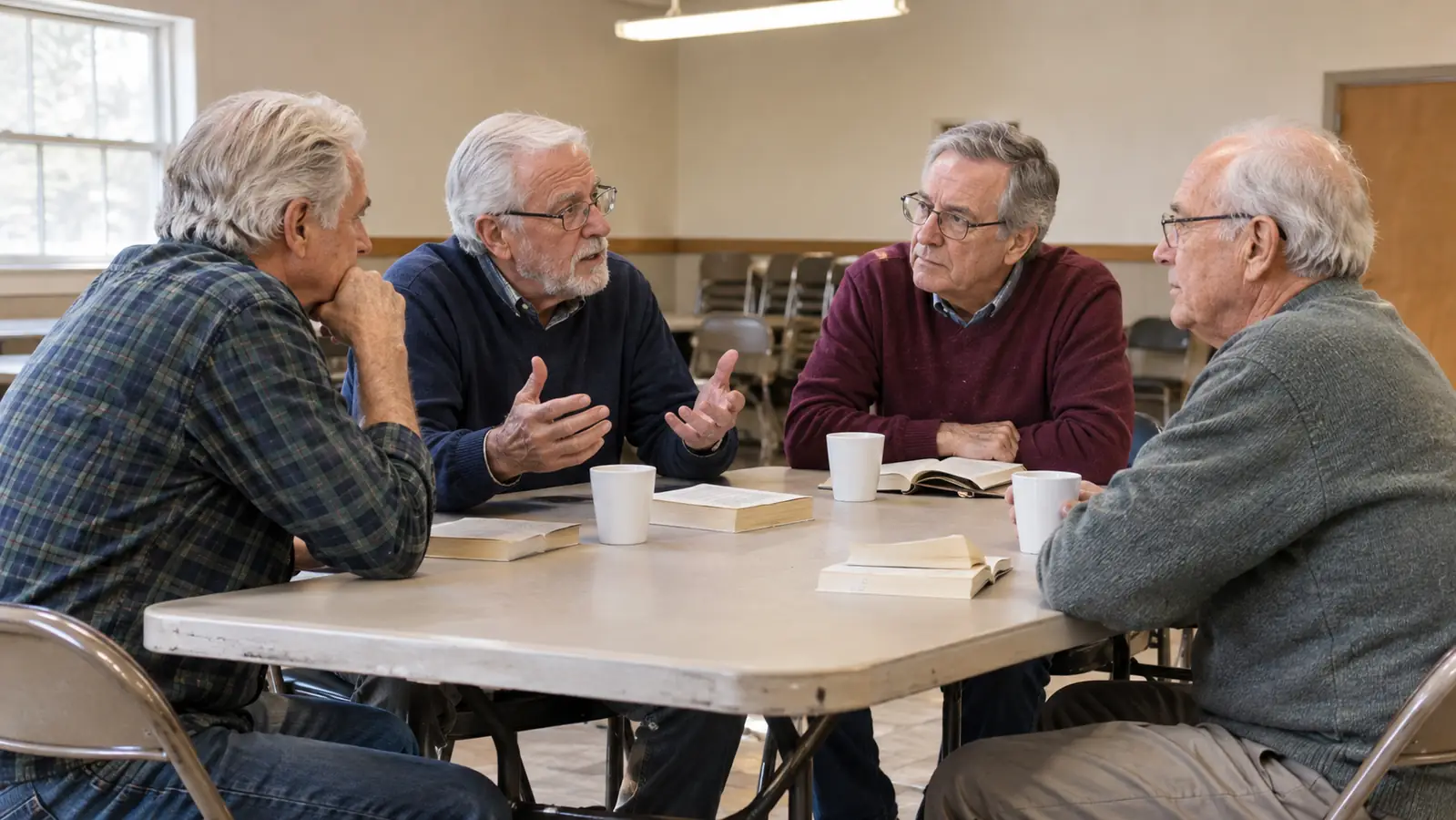
In March I ordered three paperback copies of Band of Brothers by Stephen E. Ambrose in one order, along with a few other things. I read one first, over about three weeks, sitting in the chair by the fireplace. Then the copies went around the table at the post, and from April into June the same four men, Ray, Dale, Hank and me, talked the book through at Thursday coffee after the regular talk was done. Nothing formal. No sign-up sheet. About forty minutes each time. This is what I can tell you about the book as a gift, from the only angle I have: what got read and what got talked about.
The Quick Verdict
The paperback that turned four men who mostly talk about the weather into four men arguing about a forest in France.
Amazon Check Today's Price →The book that started the arguments at our Thursday table
336 pages, Simon and Schuster paperback, Easy Company from training through Normandy to the Eagle's Nest. If the veteran in your life will read, this is the safest book gift I know of.
Amazon Check Today's Price on Amazon →How I've Used It
I bought three copies, not one. That was deliberate. A single book handed to one man is a gift. Three books handed around a table is an excuse for the table to have something to say besides the price of diesel and who is due for a doctor visit.
I finished my copy and handed the other two out on the last Thursday in March, first thing, before I had the chairs set up. Dale asked if it was a hint. Hank turned Dale's copy over and read the back cover before he said anything, which is how Hank does everything. Ray took his home, set it on the end table beside his recliner, and did not open it for nine days. I had decided that was the end of it. Then he called me on a Sunday evening to say he was sixty pages in and wanted to know whether the training chapters were accurate or dressed up for the page. I could not answer him. That phone call is what turned three paperbacks into a Thursday conversation.
I read my copy first because I wanted to be able to follow the conversation, not lead it. Three weeks, a chapter or so a night, some nights more. The paper is the ordinary Simon and Schuster trade paperback. It measures 6.25 by 9.25 inches and 1 inch thick and weighs 1.2 pounds, which matters more than you would think, because a book that heavy has to be held open with a hand rather than laid flat on a lap tray.
The copies then moved around. Ray kept his the longest and read it the way he reads everything, in the evening with the television off. Dale read it in chunks on his porch. Hank, who spent twenty years in the Air Force as an aircraft mechanic, was the slowest and the most careful, and the only one who went back and reread the early training chapters after he finished. We finished in June. The books are still on Ray's shelf and mine, and Dale still has his in the truck, which tells you something about how far it got under his skin.

What's Actually Inside Those 336 Pages
The subtitle on the cover says it plainly enough: Easy Company, 506th Regiment, 101st Airborne, from Normandy to Hitler's Eagle's Nest. Stephen E. Ambrose follows one company of paratroopers from the training they did before anyone knew where they were going, through the drop into France, through Holland and the Ardennes and into Germany at the end.
The thing that separated this book from other military histories for our table is that it stays with the same men. It is not a sweeping account of the war that checks in on a company now and then. It is one outfit, followed, so that by the middle of the book you know who is who and you care what happens at the next town. Dick Winters is the officer the book follows most closely, and he is the one name every man at our table already knew before he opened the cover.
One thing I did not expect was how much time the book spends getting the men ready before anything happens. The opening stretch is training, men learning to jump out of airplanes and getting yelled at in the cold, and if the fellow you give it to likes to be in the action by page ten, tell him to hold on, because that ground gets paid back later when you already know the faces and the names. I went back and reread the opening chapters after I finished the last of it, which I have not done with a book in twenty years, and the second time through it was a different book. What had looked like throat clearing turned out to be the reason the rest of it lands as hard as it does.
The book also does what a good gift book has to do, which is look substantial without being impossible. 336 pages, First Thus edition, English, published by Simon and Schuster with a June 2001 publication date on the copy I have. It has weight in the hand. A man who does not read much will still open it, because it does not look like homework.
What the Table Said When We Finished
I want to be careful here. Four men is four men. It is not a survey and I will not pretend it is one. What I have is one table of four at a small post in central Wisconsin, and their opinions, and that is all.
Ray, Navy, liked it for the ordinary parts. He said the sections about the men waiting, the boredom and the card games and the bad food, were the ones he recognized. Hank, twenty years Air Force as an aircraft mechanic, said he skipped nothing but read the equipment passages twice. Dale, who was in the Marines in the 1980s, was the one who argued with the book. He thought the officers came off better than the enlisted men in places, and he said so more than once, and it made for the best Thursday mornings we have had in a long while.
One Thursday in May we ran forty minutes past our usual time. Dale had marked a passage about an officer and wanted to know what the rest of us made of it. Ray, who is not a man for long arguments, took the other side, and Hank sat with his coffee and let them go. I made a second pot. By the time we broke up, the parking lot was empty except for my Buick and Ray's pickup, and Dale was still talking through the driver's window. I have known these men for years and I had never watched them go at something in a book that way. The regular talk that morning had been about a furnace, and I would rather have the argument.
Four men who usually talk about the weather spent forty minutes a week arguing about a forest in France. That is the whole case for this book as a gift.
My own read, as the civilian at the table, is that the book does the thing I always hope a history will do. It made a place I had read about in headlines feel like a place where particular men were cold and tired and did not know how the day would end. I finished it understanding something I had not understood before, and I am 68 years old and not easy to surprise.
The Book Versus the Miniseries
Ray has the HBO miniseries on DVD and we watched it together some years back, before any of this. So this is not a new comparison for us. What we both noticed, going back through the book now, is how much the series leaned on it and how much it changed.
Ray's take, and I think he is right, is that the series gives you faces and the book gives you the reasons. On screen you see a man do a thing and you move on. In the book you find out what he was thinking about before he did it, or what the man next to him thought about it afterward. The series is easier. The book stays with you longer. Neither of us would give up the other, and if the veteran in your life has only seen the series, the book is a genuinely new experience rather than a rerun.
Ray said something at the table that I have thought about since. He said the series made him quiet and the book made him talk. I think that is exactly right. Forty minutes of television leaves you sitting there with nothing to add. Three hundred and thirty six pages gives you things to say to the man beside you, and for a pair of brothers in their sixties and seventies that turned out to be worth more than I would have guessed before we started. We still bring up the same two or three chapters and we still do not agree on all of them.
Where It Frays
Three honest complaints, and I have heard all three at the table.
First, there are a lot of names. A great many men come and go across 336 pages and it is easy to lose one for fifty pages and find him again confused. Dale solved this by folding the corner of a page where a new name came up, which is not how I would treat a book, but it worked for him.
On the names I tried something of my own and it did not work. I kept a list on the back of an envelope, first and last names as they came up, thinking I would keep everybody straight and have something useful to say on Thursday. By the middle of the book the envelope was covered in names and I could not tell you which ones mattered. What worked better was reading a chapter, then setting the book down and saying out loud to nobody in the kitchen who the two or three men in that chapter were. If I could do that, I had it. If I could not, I went back a page. It slowed me down and it was worth it.
Second, the print is small on this paperback, and Ray and Hank both mentioned it. Ray has reading glasses and uses them. Hank ended up reading in the afternoon instead of at night because the light in his kitchen is better. For a man in his mid seventies, this is a real consideration and I would not wave it away.
Third, the combat chapters are hard reading, and not because the prose is difficult. They are hard because of what is happening. Nobody at our table had trouble with the words. All four of us had to put the book down at some point. If the veteran you are buying for has made it clear he does not want to go back to that, believe him and buy something else. That is not a knock on Stephen E. Ambrose. It is a fact about the reader.
What I Liked
- Stays with one company, so you learn the men instead of just the battles
- 336 pages of real substance without feeling like a textbook
- A paperback that looks and feels like a gift a reader will actually open
- Gives a series watcher a genuinely new angle on a story they think they know
- Sparked more conversation at our table than anything else in recent memory
Where It Falls Short
- A large cast of names is easy to lose track of
- The print is small for older eyes
- Some combat chapters are hard going emotionally
- Not a book to hand someone who has said he does not want to revisit the war
Who This Is For
The veteran who reads, even a little. Ray reads in the evenings with the television off. Hank reads carefully and slowly. Dale reads in chunks on the porch. None of them is a heavy reader and all three finished it.
It is also a strong choice for the family member who wants to give something with more staying power than a shirt. You are handing over an evening or two a week for a month, and at the end you can ask a real question about it. That is a better gift than most of what gets wrapped.
And it works as a shared gift. Three copies comes to less than one forgettable gadget and gives a group of men something to talk about that is not the news. If your veteran has a regular coffee group, buy more than one copy. That was the single best decision I made.
Who Should Skip It
Skip it if the man you are buying for has told you, in any words at all, that he is done with the war. Some men are. Some men went and came home and put it in a box and do not want it taken back out, and that is their right and it is not my business or yours to argue with it.
Skip it if he genuinely does not read. There is no shame in it and no gift fixes it. A man who has not finished a book in fifteen years is not going to finish this one because it came from you. Buy him something he will use instead.
And skip the paperback if his eyes are bad and he will not wear glasses. The print is small. There are other editions and I have not handled them, so I will not tell you which to buy, only that this one asks something of older eyes.
Three copies went around a table of four. Two of them are still being reread.
The Simon and Schuster paperback, 336 pages, Easy Company from training through Normandy to the Eagle's Nest. If he reads at all, he will finish this.
Amazon Check Today's Price on Amazon →I bought these in March with my own money and nobody asked me to write this. Eight months on, the copies are still on shelves and in trucks, and the Thursday table still brings the book up when the conversation runs dry. For a gift, that is about as good as it gets.