
Most war books given as gifts get about four minutes. They are opened, thanked for, and set down on a shelf beside the last one. I have bought a few of those myself, and I have watched my brother Ray be polite about them, which is worse than watching him ignore them.
The one that did not go on the shelf was Band of Brothers by Stephen E. Ambrose. The book is good, and I will get to what is inside it. What made the difference was everything after the wrapping came off: three paperback copies, the same four chairs we sit in on Thursday morning, and forty minutes of talk. We started in April and finished in June.
I am not a veteran. I am 68, retired from a parts counter at a farm equipment dealer in Stevens Point, Wisconsin, and I make the coffee at the post on Thursday mornings because my brother is a member and I am not. So when I tell you how to start a reading group like this, I am the civilian in the room. Odds are you are the civilian too: the wife, the son, the daughter, the friend who wants to hand over something a veteran will actually use instead of something he will move twice and never open.
The book that got passed around the table instead of shelved
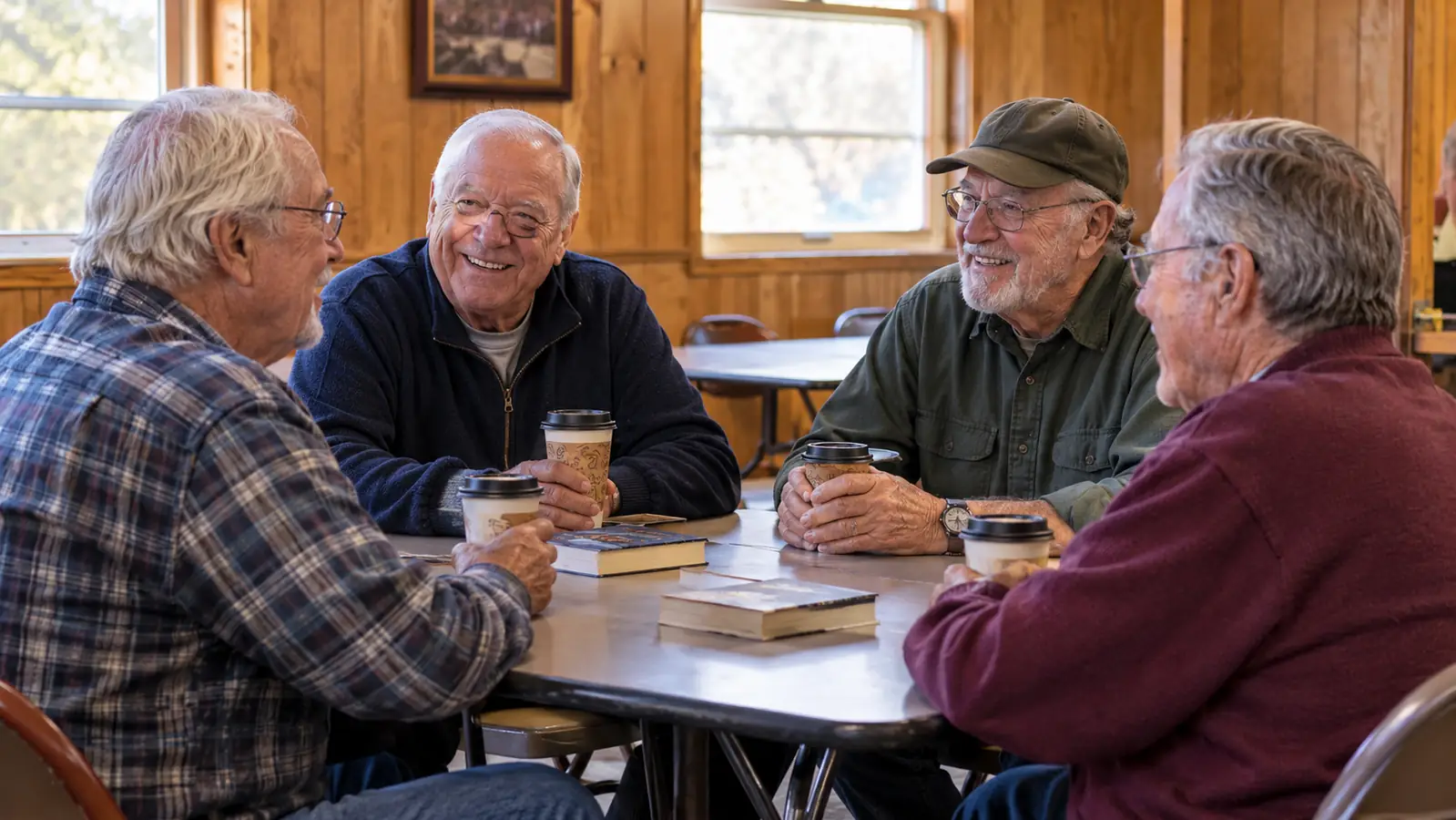
Three paperback copies held four men from April to June. 336 pages, Simon and Schuster, and a Thursday morning.
Amazon Check Today's Price on Amazon →What We Actually Did, Step by Step
Step 1: Pick a book that can be handed around without ceremony
The edition matters more than people think. The Simon and Schuster paperback runs 336 pages, weighs about a pound, and measures roughly 6.25 by 9.25 inches, an inch thick. That is a book that can ride in a tote bag, sit in a truck console, and get dropped once without ruining anyone's week. Hardbacks get treated like furniture. Paperbacks get read.
I found that out the hard way, or close to it. My first instinct back in February was to buy one hardcover and pass it around. I never ordered it, and here is why: I stood in the aisle of a bookstore in Stevens Point holding a hardcover of a different war book and realized it weighed more than my lunch pail used to and had a dust jacket that would be torn by the second man who carried it. One hardcover shared among four men is a scheduling problem. Three paperbacks is a table.
Band of Brothers by Stephen E. Ambrose follows Easy Company of the 506th Regiment, 101st Airborne, from training through Normandy to the Eagle's Nest. The one name I will put down here is Dick Winters, because his is the name that came up most at our table. There are a great many other names, and that is the first honest complaint about the book.
Three complaints, all real. There are so many names in the early chapters that Hank started a list on the back of a pancake breakfast flyer, and the flyer was full by the fourth chapter. The print in the paperback is small, and three of the four of us now read with glasses on. And the combat chapters are hard going, not because of the writing but because of the subject. If the man you are buying for does not want to go back into that, this is the wrong book and no reading group will fix it.

Step 2: Keep the table to four chairs
Our table is Ray, who was in the Navy from 1970 to 1974 and worked as a machinist's mate; Dale, who was in the Marine Corps in the 1980s; Hank, who retired after twenty years in the Air Force as an aircraft mechanic; and me. Four men, four chairs, and no fifth chair pulled up, even when somebody asks.
Four is the number where everybody talks. At ten, three men carry the conversation and seven listen, and the seven stop coming by the third week. We never had a sign-up sheet, we never took minutes, and we never gave the group a name. It was Thursday coffee with a book on the table, and I think that is the only reason it lasted.
The mix of branches helped more than I expected. A Navy man, a Marine and an Air Force man will disagree about almost anything except the coffee, and that disagreement is the conversation. The sharpest one came in May, over a chapter about supply and who was getting what and when. Hank, who spent twenty years keeping aircraft flying with parts he had to chase down, had a view on it that Dale did not share at all. I stirred my coffee and stayed out of it. That is what I heard at one table of four. It is not a survey of anybody.
Step 3: Read it yourself before you hand it out
I read one of the three copies over about three weeks in March, at the kitchen table in the evening, before I handed anything to anybody. Part of that was wanting to know what I was putting in a man's hands. Part of it was not wanting to be the civilian who recommends a book he has never opened.
Reading it first bought me the right to ask questions instead of making statements. At that table, a question is welcome. An opinion from the man who never served is tolerated for about one sentence. If you want to be useful in the conversation, come with a question about what a man thinks, not a summary of what you read.
It also told me where the book drags. Every long book has a stretch that slows down, and knowing where it slows means you can say so out loud when somebody else hits it and starts to fade. For me that stretch was the middle, where the names pile up faster than the story moves. I finished the last hundred pages in four sittings and the first two hundred took me better than two weeks. When Hank hit the same wall in May I was able to tell him it opens back up, and he stayed with it. That one sentence may have been the most useful thing I did all spring.
Three paperback copies, four chairs, and forty minutes on a Thursday from April to June. That was the entire program.

Step 4: Hand them over in person, with no speech
I ordered three paperbacks of Band of Brothers by Stephen E. Ambrose in the first week of March, in the same order as a few other things I was buying that month, and they came in the same box. If you are doing this for a table of four, three copies is enough. Somebody is always borrowing.
I read mine first, then put the other two on the table on the last Thursday of that month and said nothing worth remembering. No wrapping, no toast, no speech about how much it means. Dale picked his up and read the back cover before I got two words out. That is the correct amount of ceremony, which is none.
Three copies for four chairs means the books travel. Ours got passed around more than they got carried home, and a book that is being passed is a book that is being talked about, which is the whole point of doing it this way instead of dropping one on a shelf. By the end of April I could not have told you which copy was mine. Ray had one on his truck seat, Dale had one on his kitchen counter under a bag of pretzels, and Hank had one with a receipt in it at page ninety four. In June they came back to me one at a time, and I put all three in the bookcase in the living room, and there they have sat since.
Step 5: Set a clock and stop at forty minutes
We started in April and finished in June. Forty minutes, at Thursday coffee, after the regular talk about who is having surgery and whose truck is making a noise. No page assignments. No reading schedule. A man read at his own pace and came on Thursday either way.
Stop at forty even when it is going well, especially when it is going well. Good conversation turns into homework the moment it runs long, and homework is what none of these four men signed up for. At forty minutes you leave the table wanting the next Thursday, and wanting it is the whole trick. I kept a eye on the clock on the wall by the coffee urn, the one that runs four minutes fast, and I gave it a tap at the thirty five mark so the last few minutes went to whoever had been quiet.
The only rule worth writing down: a man who has not read still gets to talk. Ray reads fast. Hank reads slow and careful. I read like a man with a pencil in my hand. If you only let the finished readers speak, the group becomes a test, and one man quietly stops coming and never says why.
What Else Helps
Ray and I watched the HBO miniseries together on his DVD set some years back, long before I bought the paperbacks. He likes the series better. He says putting faces to the names is what he needed, and he has watched the whole thing twice. I like the book better, because I can stop and go back, and because Stephen E. Ambrose does not tell me how to feel about a scene. That is two brothers arguing in a driveway, not a verdict on anything. If you are weighing one against the other as a gift, there is a full comparison on this site.
A lamp near the chair helps more than any advice I can give. So does a pair of reading glasses that are not the pair left out in the truck, and a bookmark that is not a folded receipt. Small things. But a man reading small print in bad light at the end of a long day will quit on the book and blame the book, and then the group loses a chair. Ray's den has one floor lamp behind the recliner, and after the first week he moved it around to the side so the light came over his shoulder instead of into his eyes. He told me that like it was a discovery. It was, for him.
If you are buying for a post instead of for a person, buy two copies, not twelve. Twelve copies in a box is a project that needs a chairman and a schedule. Two copies on a table is an invitation, and an invitation is easier to say yes to. You can add a third when somebody asks for one, which a man will do in his own time.
One more thing that helped: nobody was told the group would do anything for him. Not for his mood, not for his sleep, not for anything at all. It is four men talking about a book for forty minutes, and that is the honest description. The minute you promise more than that, you have made a promise you cannot keep, and the men at the table will know it before you finish the sentence.
What did not help: a schedule posted at the post, a group text, and a name for the group. All three were suggested once, in April, by me. All three died on the table in under a minute. Dale said we already know what day it is, and that was the end of the schedule. If you take one thing from a civilian who watched it work, take that.
Start with one copy and one Thursday
You do not need a group first. Buy the book, read a chapter, and set it on the table. The rest starts itself.
Amazon See Current Price on Amazon →